
Introduction: Move Beyond Learning to Doing
Have you ever wondered why some people learn digital marketing and confidently start working on real projects, while others struggle to apply what they have learned?
The difference often lies in practical experience.
If you want to learn digital marketing, understanding concepts such as Search Engine Optimization (SEO), social media marketing, content marketing, paid advertising and analytics is an important first step. However, knowing the theory is not enough. You also need to understand how these skills work in real business situations.
Imagine being able to show a potential employer or client a website you optimized, a social media campaign you planned, a keyword research report you prepared, or a sample advertising campaign you created. These practical examples can help demonstrate your abilities more effectively than simply listing skills on your résumé.
The good news? You do not need to wait for your first job or client to start building experience.
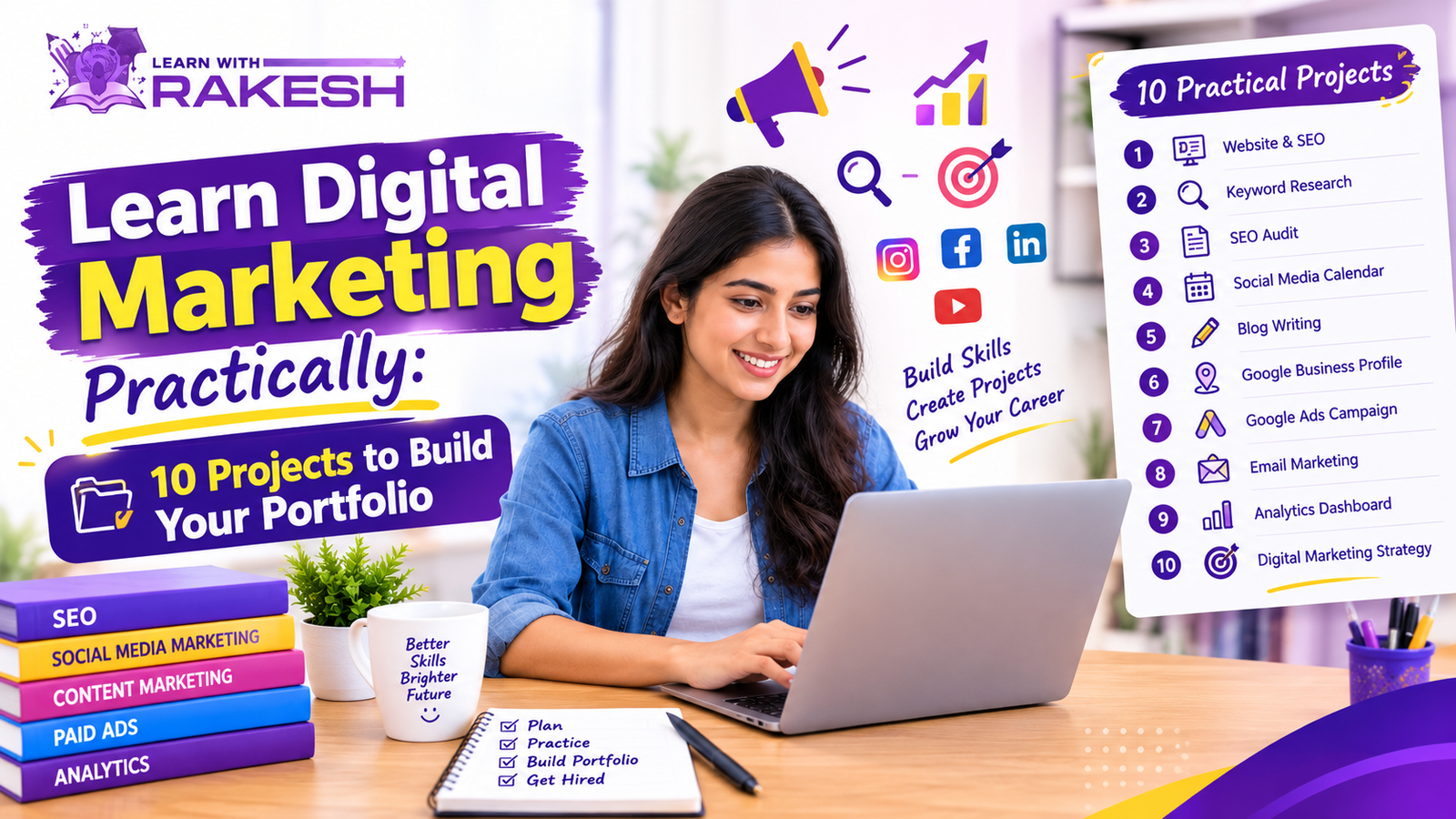
In this guide, we will explore 10 practical digital marketing projects for beginners that can help you develop essential skills, create a portfolio, and prepare for future opportunities.
Whether you are a student, job seeker, working professional, business owner, or aspiring freelancer, these projects will help you turn digital marketing knowledge into practical skills.
Why Is Practical Learning Important in Digital Marketing?
Digital marketing involves solving real business problems. Businesses want to improve online visibility, attract relevant audiences, generate leads, increase sales, and build long-term customer relationships.
Practical projects help you understand how to work toward these goals.
Here are five reasons to learn digital marketing through hands-on practice.
1. Understand How Digital Marketing Works
Reading about SEO is different from conducting keyword research for a website. Similarly, learning about social media marketing is different from planning a content calendar and evaluating engagement.
Practical work helps connect concepts with real activities.
2. Develop Job-Ready Skills
Projects allow you to practice the tasks that digital marketing professionals may perform, such as researching keywords, creating content, preparing reports, and analyzing campaign performance.
3. Build a Digital Marketing Portfolio
A portfolio is a collection of your work that demonstrates your skills and problem-solving approach. It can include sample campaigns, website audits, content calendars, reports, and case studies.
4. Prepare for Freelancing Opportunities
If you want to become a freelancer, practical projects can help you understand service delivery, client requirements, project planning, and reporting.
You can begin with sample projects before approaching potential clients.
5. Learn to Measure Results
Digital marketing is not just about publishing content or running advertisements. It also involves understanding performance data and identifying opportunities for improvement.
Projects help you practice making decisions based on measurable information.
10 Practical Digital Marketing Projects for Beginners
Here are ten projects you can start working on while learning digital marketing.
Project 1: Build and Optimize a Website for a Sample Business
Skills you will learn: Website planning, content creation, on-page SEO, user experience, and conversion optimization.
A website is an important foundation for many digital marketing activities. Building or optimizing one helps you understand how design, content, search visibility, and lead generation work together.
What should you do?
Choose a sample business, such as a coaching institute, restaurant, digital marketing agency, salon, or local service provider.
Create a simple website or a demonstration website with the following pages:
- Home
- About Us
- Services
- Blog
- Contact Us
Then optimize the website by writing descriptive page titles, organizing headings, adding relevant keywords, improving navigation, and creating clear calls to action.
Also check mobile usability, page performance, broken links, and image optimization.
Your portfolio deliverable
Prepare a short case study containing:
- The business concept and target audience.
- Website structure and design screenshots.
- Examples of on-page SEO improvements.
- A list of technical or usability issues identified.
- Recommendations for improving inquiries or conversions.
Pro tip: You can use a personal practice website or a clearly labelled demonstration project. Do not claim that a sample website generated actual business results.
Project 2: Conduct Keyword Research for a Business
Skills you will learn: Keyword research, search intent, content planning, and competitor analysis.
Keyword research helps you understand what people search for when looking for information, products, or services.
For example, a digital marketing training institute might target searches related to learning digital marketing, digital marketing courses, SEO training, and digital marketing careers.
What should you do?
- Choose a business or niche.
- Identify its products, services, and target audience.
- Research relevant keywords using tools such as Google Keyword Planner, Google Trends, or other suitable SEO tools.
- Group keywords by search intent.
- Identify suitable keywords for website pages and blog articles.
- Prioritize keywords based on relevance, competition, and realistic opportunities.
Create a spreadsheet with columns for the keyword, search intent, target page, estimated search volume where available, competition, and content idea.
Your portfolio deliverable
Prepare a keyword research report with at least 30 relevant keyword ideas, grouped into suitable categories.
This project is particularly valuable for people who want to develop SEO skills.
Project 3: Perform an On-Page SEO Audit
Skills you will learn: On-page SEO, website analysis, content optimization, and SEO reporting.
On-page SEO helps search engines and users understand the content and purpose of a webpage.
In this project, select a website you own or have permission to analyze.
What should you check?
- SEO titles and meta descriptions.
- H1 and H2 heading structure.
- Keyword relevance and search intent.
- Content quality and usefulness.
- Internal linking.
- Image alt text.
- URL structure.
- Mobile usability.
- Page performance.
- Indexing and crawlability indicators.
Tools such as Google Search Console, PageSpeed Insights, and browser-based inspection tools can help you investigate different aspects of a website.
Your portfolio deliverable
Create an SEO audit report with three sections:
Existing issues: What needs improvement?
Recommended solutions: What changes would you make?
Priority level: Which changes should be addressed first?
Where possible, record the baseline data and measure the results after implementing your recommendations. Remember that SEO improvements do not guarantee higher rankings, and meaningful results may take time.
Project 4: Create a 30-Day Social Media Content Calendar
Skills you will learn: Social media strategy, content planning, copywriting, creative direction, and audience engagement.
Businesses need more than occasional social media posts. They need a consistent content strategy that serves their audience and supports business goals.
What should you do?
Choose a business and select one or two suitable social media platforms.
Create a 30-day content calendar with a mixture of:
- Educational posts.
- Tips and how-to content.
- Reels and short videos.
- Product or service highlights.
- Customer questions and FAQs.
- Behind-the-scenes content.
- Testimonials, where genuine permission has been obtained.
- Promotional posts and calls to action.
For every content idea, specify the objective, target audience, caption, creative format, publishing date, and call to action.
Your portfolio deliverable
Prepare a complete content calendar and design at least five sample creatives using tools such as Canva or other suitable design software.
You can also create sample captions and short-form video scripts.
Pro tip: A strong social media portfolio demonstrates both creativity and strategic thinking. Explain why you selected each content format rather than simply displaying attractive designs.
Project 5: Create an SEO-Friendly Blog Article
Skills you will learn: Content strategy, keyword placement, search intent analysis, writing, and on-page SEO.
Content marketing is an important part of digital marketing because useful content can answer customer questions, support organic visibility, and build trust.
What should you do?
Choose a topic relevant to your selected business. For example, if you are promoting a digital marketing training program, you might write an article about essential digital marketing skills for beginners.
Follow these steps:
- Identify the primary focus keyword.
- Research the questions and needs of the target audience.
- Analyze the search intent behind the keyword.
- Prepare a logical outline using H1, H2, and H3 headings.
- Write original, useful content.
- Add relevant internal and authoritative external links.
- Optimize the SEO title, meta description, URL, and images.
- Include a relevant call to action.
For example, a training website could naturally invite readers to explore its digital marketing course after explaining the skills and learning roadmap.
Your portfolio deliverable
Publish an article on your practice website, if available, and prepare a short document explaining your keyword selection, content structure, on-page SEO decisions, and internal linking strategy.
This project is especially relevant if your goal is to become an SEO executive or content marketer.
Project 6: Set Up a Google Business Profile Strategy
Skills you will learn: Local SEO, business information optimization, review management, and local search visibility.
Local businesses often depend on customers searching for nearby products and services. A well-maintained Google Business Profile can help eligible businesses appear in relevant Google Search and Maps results.
What should you do?
Select a local business and prepare an optimization plan covering:
- Accurate business name and contact information.
- Appropriate primary and additional categories.
- Business hours and service information.
- Relevant photos and videos.
- Service descriptions.
- A plan for requesting genuine customer reviews.
- Responses to customer feedback.
- Useful updates and posts where available.
If the business already has a profile, conduct an audit with permission. If you are working on a hypothetical business, create a sample strategy instead of publishing false business information.
Your portfolio deliverable
Prepare a local SEO checklist and a proposed profile optimization plan. If you have authorized access to a real business profile, document relevant baseline observations and subsequent changes.
This project can be particularly useful when approaching local businesses as potential clients.
Project 7: Create a Sample Google Ads Campaign
Skills you will learn: Paid search strategy, keyword selection, ad copywriting, budgeting, and conversion tracking.
Paid advertising allows businesses to reach relevant audiences through advertising platforms. Learning how to structure a campaign is valuable even before you manage a real advertising budget.
What should you do?
Choose a product or service and prepare a mock Google Ads search campaign.
Your plan should include:
- Campaign objective.
- Target audience and locations.
- Keyword groups.
- Sample responsive search ad headlines.
- Ad descriptions.
- Landing page recommendations.
- Negative keyword ideas.
- Proposed budget and bidding approach.
- Conversion tracking requirements.
For example, a digital marketing training institute might create a campaign plan targeting people interested in professional digital marketing training.
Clearly label your work as a sample campaign if no advertisements were actually launched.
Your portfolio deliverable
Prepare a campaign strategy document containing sample ads, keyword groups, landing page suggestions, and a measurement plan.
If you later manage an authorized live campaign, you can add actual performance data with the client’s permission.
Project 8: Build an Email Marketing Campaign
Skills you will learn: Email copywriting, audience segmentation, campaign planning, and performance measurement.
Email marketing can help businesses nurture relationships with people who have voluntarily subscribed to receive communications.
What should you do?
Develop a sample email campaign for a product, service, or educational program.
Create a short sequence such as:
- Welcome email.
- Educational email.
- Helpful resource or guide.
- Service or course introduction.
- Follow-up email with a relevant call to action.
Write subject lines, preview text, email body copy, and calls to action.
You can also prepare a basic plan for subscriber segmentation, consent management, unsubscribe options, and performance tracking.
Your portfolio deliverable
Prepare five sample emails and explain the purpose of each message in the sequence.
Use a test list or an appropriately consented audience. Never add people to marketing lists without permission.
Project 9: Create a Marketing Analytics Dashboard
Skills you will learn: Data analysis, performance reporting, conversion measurement, and campaign optimization.
Digital marketing professionals need to understand whether their activities are helping achieve business objectives.
This project introduces you to the relationship between marketing activities and measurable outcomes.
What should you do?
Use a demo account, your own website data, or a clearly labelled sample dataset.
Build a simple dashboard using a spreadsheet or an appropriate reporting tool. Depending on the available data, include metrics such as:
- Website sessions.
- Traffic sources.
- Landing page performance.
- Click-through rate.
- Conversion rate.
- Leads generated.
- Cost per lead.
- Advertising spend and return on ad spend, where reliable revenue and cost data are available.
Do not calculate or report metrics when the required underlying data is missing.
Your portfolio deliverable
Create a dashboard with charts, key observations, and three actionable recommendations.
For example, you might identify a landing page that attracts visitors but has a relatively low conversion rate, then recommend testing its headline, form, or call to action.
Important: Use real measurements only when you have the underlying data. Clearly identify simulated or sample data so viewers do not mistake it for actual business performance.
Project 10: Develop a Complete Digital Marketing Strategy for a Business
Skills you will learn: Strategy development, audience research, channel selection, budgeting, and integrated campaign planning.
This final project brings together the skills you have practiced in the previous nine projects.
Choose a sample business and create an integrated digital marketing strategy.
What should you include?
1. Business overview: Describe the business, products, services, and objectives.
2. Target audience: Define the audience’s needs, interests, and challenges.
3. Competitor analysis: Examine publicly available competitor websites, content, positioning, and marketing activities.
4. Website strategy: Recommend improvements to the website and conversion journey.
5. SEO strategy: Identify relevant keywords, content opportunities, and technical priorities.
6. Social media strategy: Select suitable platforms and develop content themes.
7. Paid advertising strategy: Propose campaign objectives, targeting, budgets, and landing pages.
8. Content marketing plan: Prepare a blog calendar and supporting content ideas.
9. Email marketing plan: Explain how to nurture consenting subscribers.
10. Measurement plan: Define relevant KPIs and reporting frequency.
Your portfolio deliverable
Create a digital marketing strategy presentation or PDF explaining your research, recommendations, proposed timeline, estimated budget, and success metrics.
This capstone project can demonstrate that you understand how different digital marketing channels work together rather than treating each skill as an isolated activity.
How to Build Your Digital Marketing Portfolio
After completing these projects, organize your work into a portfolio that is easy for employers and potential clients to understand.
You can use a simple website, a presentation, a PDF document, or a professional online portfolio.
For each project, include the following information:
Project objective: What problem were you trying to solve?
Approach: What research, tools, and methods did you use?
work: Show relevant screenshots, sample creatives, reports, or campaign plans.
Your findings: Explain what you discovered or what you learned.
Next steps: Describe how you would improve the project further.
Where you have real performance data, include the results and explain your contribution. For practice projects, focus on your process, deliverables, and reasoning rather than claiming unverified outcomes.
Remember, you do not need ten perfect projects before applying for opportunities. Start with a few high-quality examples that demonstrate the skills relevant to your career goals.
Which Tools Can You Use to Learn Digital Marketing Practically?
You can start with a combination of free tools and trial versions where available. Tool access, features, and pricing may change over time.
| Skill | Example tools |
|---|---|
| SEO and keyword research | Google Search Console, Google Keyword Planner, Google Trends |
| Website performance | PageSpeed Insights |
| Website creation | WordPress and other website builders |
| Social media creatives | Canva |
| Content writing | Google Docs and AI writing assistants |
| Paid advertising | Google Ads |
| Analytics | Google Analytics 4, Looker Studio |
| Email marketing | Email marketing platforms with suitable free or trial plans |
| Reporting | Google Sheets or Microsoft Excel |
You do not need to master every tool at once. Focus on understanding the marketing concept behind each tool and practice applying it to a relevant project.
A 30-Day Practical Learning Plan for Beginners
If you are wondering how to get started, here is a simple four-week plan.
First Week: Build the foundation
- Learn digital marketing fundamentals.
- Understand your target audience and customer journey.
- Research keywords for a sample business.
- Create a basic website structure.
Second Week: Practice SEO and content marketing
- Conduct an on-page SEO audit.
- Write an SEO-friendly blog.
- Create a content calendar.
- Design sample social media posts.
Third Week: Explore advertising and communication
- Plan a sample Google Ads campaign.
- Draft an email marketing sequence.
- Study conversion tracking and campaign objectives.
Fourth Week: Analyze and present your work
- Create a sample analytics dashboard.
- Prepare a complete digital marketing strategy.
- Organize your work into a portfolio.
- Identify the skills you need to improve next.
Adjust the schedule according to your available time and prior knowledge. Thirty days can help you establish a foundation, but developing professional competence requires continued practice and feedback.
Common Mistakes to Avoid While Learning Digital Marketing
Many beginners make avoidable mistakes when they start learning digital marketing.
Focusing only on certificates
Certificates can demonstrate course completion, but practical work helps demonstrate what you can actually do.
Learning too many tools at once
Start with the essential tools for your chosen skill area. Learn to use them effectively before adding more.
Copying other people’s projects
Use competitor research for inspiration, but develop your own strategy, content, and recommendations.
Ignoring analytics
Do not judge a campaign solely by likes, impressions, or website traffic. Choose metrics that align with the actual objective.
Expecting instant results
SEO, audience development, and marketing optimization take time. Focus on consistent practice, measurement, and improvement.
Building a portfolio without explaining your decisions
Screenshots alone may not communicate your abilities. Explain the problem, your approach, and why you made particular choices.
Why Learn Digital Marketing with Learn with Rakesh?
Learning digital marketing becomes more meaningful when you can connect concepts with practical tasks and real-world business scenarios.
Learn with Rakesh, led by Digital Marketing Expert Rakesh Mohanty, aims to help learners understand digital marketing skills and how they can be applied in practice.
With 14+ years of industry experience, Rakesh brings professional experience to the learning journey. Learners interested in building their digital marketing knowledge can explore training that covers relevant areas such as:
- Search Engine Optimization (SEO).
- Social Media Marketing and Optimization.
- Website Design and Development.
- Content Writing and Creative Design.
- Paid Advertising.
- Email and WhatsApp Marketing.
- AI tools for digital marketing.
- Freelancing and career preparation.
The objective is to help learners develop a stronger understanding of digital marketing and work toward applying their skills in practical situations.
Whether you are a student exploring career options, a professional planning a career transition, or an aspiring freelancer, choose a learning path that gives you opportunities to practice, receive feedback, and build a portfolio.
Explore the learning opportunities available through Learn with Rakesh at:
Website: https://www.digitalmarketingexpertrakesh.com
Learn. Implement. Grow. Earn More.
Frequently Asked Questions (FAQs)
1. How can I learn digital marketing practically?
Start with the fundamentals, choose a specific skill such as SEO or social media marketing, and apply it to a sample business or a project you have permission to work on. Document your process and gradually build a portfolio.
2. Can beginners learn digital marketing without experience?
Yes. Beginners can start with foundational concepts and build their knowledge through structured practice. You can use sample websites, mock campaigns, and demonstration datasets before working on real client projects.
3. What projects should I include in a digital marketing portfolio?
Useful examples include keyword research, website audits, SEO blog articles, social media calendars, sample advertising campaigns, email sequences, analytics dashboards, and integrated marketing strategies.
4. Do I need a website to learn digital marketing?
No. You can begin with research, content planning, sample campaigns, and reporting exercises. However, having access to a practice website can help you develop website optimization, SEO, analytics, and conversion measurement skills.
5. Can I learn digital marketing for freelancing?
Yes. Practical projects can help you develop relevant skills and demonstrate your approach to potential clients. You should also learn client communication, project management, pricing, reporting, and how to define the scope of your services.
6. How long does it take to learn digital marketing?
The time required depends on your starting knowledge, available study time, learning approach, and chosen specialization. You can establish a foundation in a few weeks, but developing reliable professional skills generally requires ongoing practice.
7. Is AI important at the time learning digital marketing in 2026?
AI tools can assist with research, content ideation, data analysis, and workflow automation. However, you still need to develop marketing judgment, critical thinking, originality, data interpretation, and the ability to verify AI-generated information.
8. Where can I learn digital marketing with practical guidance?
Look for a learning program that combines foundational knowledge, practical exercises, feedback, portfolio development, and guidance relevant to your goals. You can explore the learning opportunities offered by Learn with Rakesh at https://www.digitalmarketingexpertrakesh.com.
Conclusion: Start Building Skills Through Practical Experience
Digital marketing is best learned through a combination of knowledge, experimentation, analysis, and consistent practice.
From website optimization and keyword research to social media campaigns and analytics dashboards, each project in this guide can help you develop a different part of your digital marketing skill set.
You do not need to wait until you get a job or your first client to begin building a portfolio. Start with one project, complete it carefully, document what you learn, and use that experience to tackle the next challenge.
If you want to learn digital marketing and develop skills relevant to modern business needs, take the first step toward structured learning and practical application.
Explore Learn with Rakesh and work toward building the knowledge, confidence, and portfolio you need for your next stage of growth.
Learn. Implement. Grow. Earn More.