
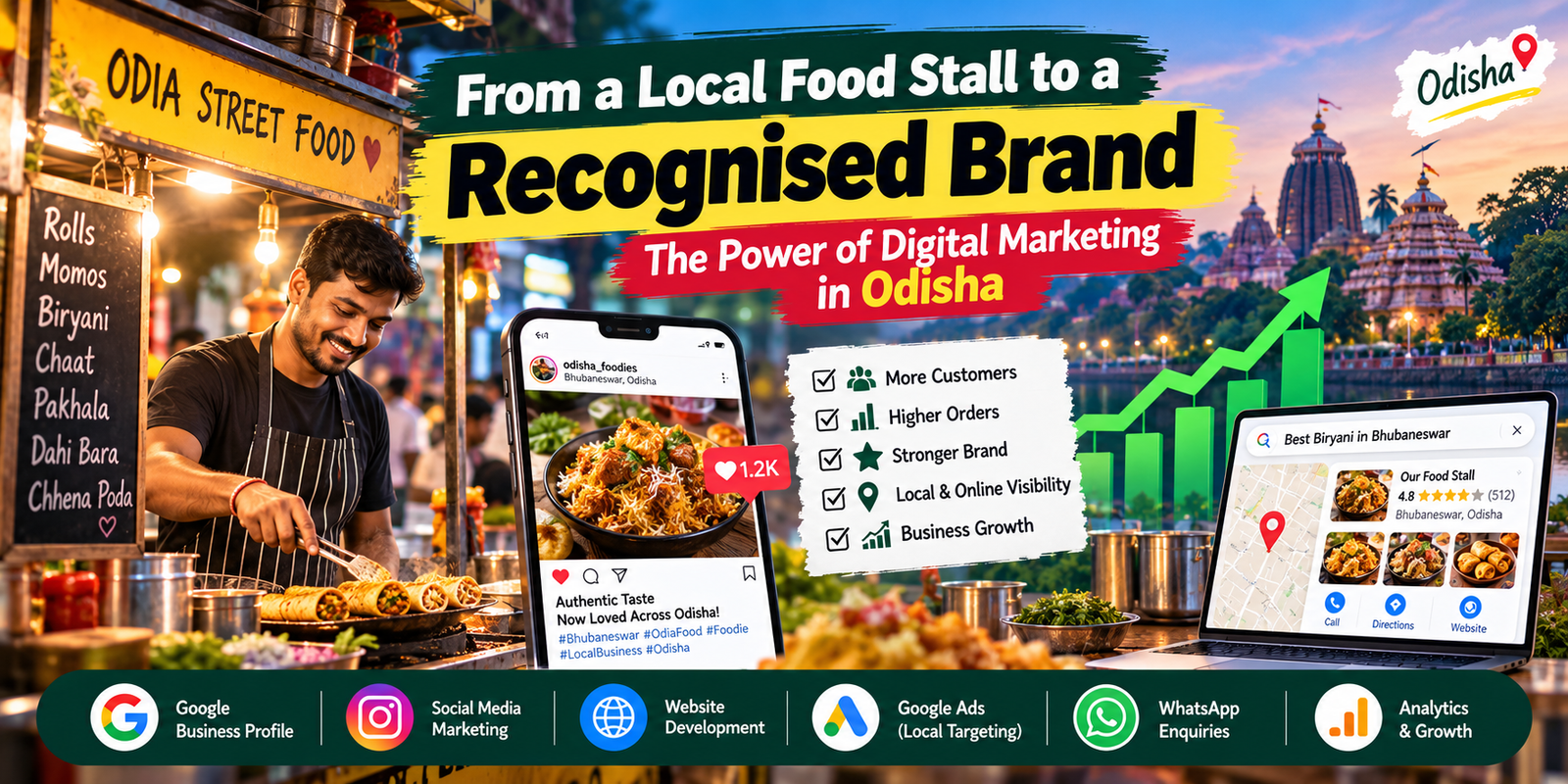
Imagine a small food stall in Bhubaneswar that serves delicious biryani, rolls, momos, or traditional Odia snacks. Customers who discover the stall love the food, and some even recommend it to their friends. Yet, many people living just a few kilometres away have never heard of it.
Now imagine another food business selling similar products. It regularly shares appetising food photographs, appears in local Google searches, publishes customer reviews, and makes it easy for people to enquire about orders.
Which business has a better chance of reaching new customers?
Good food is essential, but potential customers must also discover your business before they can place an order.
This is where digital marketing for food businesses in Odisha can make a difference. With the right online strategy, local food stalls, restaurants, dhabas, cafes, bakeries, and cloud kitchens can improve their online visibility, communicate with customers, and build a recognisable brand.
Whether your food business operates in Bhubaneswar, Cuttack, Puri, Sambalpur, or another part of Odisha, you can start building your digital presence with practical, measurable steps.
Why Do Food Businesses in Odisha Need Digital Marketing?
Think about how people choose where to eat today. Someone looking for a restaurant may search Google Maps, check photographs on Instagram, read customer reviews, or ask friends for recommendations on WhatsApp.
If your business has little or no online presence, potential customers may find it difficult to discover your menu, location, opening hours, or ordering options.
Digital marketing helps bridge this gap between your food business and the people who may want to visit or order from you.
Here are five important benefits.
1. Reach More Local Customers
Local customers are often the most valuable audience for restaurants and food outlets because they can visit your location or order within your delivery area.
Local SEO, Google Business Profile optimisation, social media content, and location-relevant website pages can help customers discover your business when they are looking for food nearby.
For example, a restaurant in Patia may want to attract people searching for restaurants in Patia or nearby areas. A food stall in Cuttack may want to reach customers searching for popular snacks around its actual location.
Your online content should clearly communicate what you sell, where you operate, and how customers can reach you.
2. Build a Recognisable Food Brand
A food business becomes more memorable when its name, visual identity, menu, photographs, and communication style remain consistent.
A recognisable brand does not necessarily require an expensive interior or a large advertising budget.
Start with a clear business name, a readable logo, consistent colours, professional food photographs, and accurate business information across your online channels.
When customers repeatedly encounter consistent branding, they can more easily recognise your business and distinguish it from competitors.
3. Showcase Your Food Through Visual Content
Food is a highly visual product. A well-lit photograph of a freshly prepared meal or a short video showing how a popular dish is prepared can make your social media content more appealing.
Restaurants and food businesses can create content around:
- Signature dishes and best-selling items.
- Food preparation and behind-the-scenes activities.
- Daily menus and new product launches.
- Customer experiences, with permission.
- Festival specials and seasonal menus.
- Kitchen hygiene and food preparation practices.
- Special offers with clear terms and conditions.
You do not need to publish promotional content every day. A balanced mix of informative, engaging, and promotional posts can help maintain audience interest.
4. Build Trust Through Reviews
Customers often look at ratings, reviews, photographs, and responses before deciding where to eat.
Encourage genuine customers to share honest feedback about their experiences. Respond professionally to both positive and negative reviews, and address legitimate concerns wherever possible.
Avoid buying fake reviews or offering incentives in exchange for positive ratings.
According to Google’s guidance on improving local rankings, local search visibility is influenced by relevance, distance, and prominence. Complete business information, reviews, and photographs can help customers understand your business and make informed decisions.
5. Make It Easier for Customers to Enquire or Order
Marketing should do more than generate likes and views. It should make the next step clear.
Depending on your business model, your website and social media profiles can direct customers to:
- Call your business.
- Send an enquiry through WhatsApp.
- View your menu.
- Request catering information.
- Find directions to your outlet.
- Place an order through your supported ordering channel.
Make sure the information is accurate and that customers know what to do after discovering your business.
7 Digital Marketing Strategies for Food Businesses in Odisha
You do not need to implement every marketing channel at once. Begin with the activities most relevant to your business, budget, location, and target customers.
1. Optimise Your Google Business Profile
A Google Business Profile can help an eligible food business appear in relevant Google Search and Google Maps results.
Start by claiming or creating your profile and completing the information accurately.
Your profile should include:
- The real-world business name.
- The most appropriate primary business category.
- Accurate address or service-area information, as applicable.
- Correct opening hours and contact details.
- Your website, if available.
- High-quality photographs of your food, premises, and menu.
- Relevant menu and ordering information where supported.
Keep your information updated whenever your opening hours, menu, or contact details change.
For example, a family restaurant in Bhubaneswar should ensure that customers can find its correct location and current opening hours before planning a visit.
Read the official Google Business Profile guidelines before making changes to your listing.
Remember that creating a profile does not guarantee top rankings. Local visibility depends on multiple factors, including the searcher’s location and the relevance and prominence of your business.
2. Use Local SEO to Attract Relevant Searches
Search engine optimisation helps your website become more understandable and discoverable through organic search.
For a food business, local SEO should focus on the actual dishes, services, and areas you serve.
Consider relevant search phrases such as:
- Restaurant in Bhubaneswar.
- Best biryani in Cuttack.
- Family restaurant near Patia.
- Cloud kitchen in Bhubaneswar.
- Catering services in Puri.
- Traditional Odia food in Bhubaneswar.
Use these phrases naturally in relevant page titles, headings, menu pages, and website content. Only target locations where your business genuinely operates or provides services.
If you have a website, create useful pages that explain your menu, speciality dishes, location, ordering process, and customer service details.
For more guidance, read Google’s SEO Starter Guide.
3. Create Engaging Instagram and Facebook Content
Social media can help food businesses showcase their products, communicate with customers, and build brand recognition.
Instead of publishing only menu images, develop a simple weekly content plan.
For example:
- Monday: Introduce a signature dish.
- Tuesday: Share a short food preparation video.
- Wednesday: Publish your popular meal combinations.
- Thursday: Share a customer question or answer.
- Friday: Highlight a weekend special.
- Saturday: Post a behind-the-scenes video.
- Sunday: Share the upcoming week’s menu or a customer favourite.
Adapt the schedule to your business operations. The objective is to publish useful, authentic content consistently rather than simply increasing the number of posts.
Use clear photographs, readable text, location information, and a relevant call to action.
4. Use WhatsApp to Manage Customer Enquiries
WhatsApp can be a practical communication channel for food businesses that receive enquiries about menus, prices, delivery availability, catering, and bookings.
A business can use WhatsApp Business features to organise customer conversations, share its catalogue where appropriate, and provide essential business information.
Consider setting up:
- A clear business profile.
- An updated menu or catalogue, where suitable.
- Quick replies for common questions.
- Business hours and contact information.
- A simple enquiry and order-handling process.
Ask customers for permission before sending promotional messages, respect their communication preferences, and follow applicable messaging rules.
If your business receives enquiries from multiple channels, tracking where each enquiry originated can help you understand which marketing activities are working.
5. Invest in Paid Advertising Strategically
Google Ads and Meta Ads can help eligible food businesses reach selected audiences and promote specific offers or services.
However, advertising should begin with a clear business objective.
You may want to promote a new menu, attract visitors to a restaurant, generate catering enquiries, or reach people within a suitable delivery area.
Before launching a campaign, determine:
- Your target audience and location.
- The product or service being promoted.
- The offer and its terms.
- Your total budget.
- The preferred enquiry or ordering method.
- How you will measure results.
Start with a manageable test budget and evaluate actual enquiries, orders, or visits where tracking is possible.
Do not judge campaign performance solely by impressions, likes, or clicks. A campaign that generates many clicks but few relevant enquiries may need a different audience, message, offer, or landing page.
6. Build a Website That Converts Visitors Into Customers
A professional website can provide a central place for customers to explore your food business.
Your website should make essential information easy to find, especially on mobile devices.
Consider including:
- Home page with a clear introduction.
- Menu and speciality dishes.
- Food photographs.
- Location and opening hours.
- Ordering or enquiry options.
- Catering or event services, if offered.
- Customer reviews where appropriately displayed.
- Contact information and relevant policies.
If you operate a cloud kitchen, clearly explain the areas you serve, how ordering works, and the expected service arrangements.
Use descriptive page titles, helpful content, fast-loading images, and clear calls to action.
A website does not automatically produce orders. Its effectiveness depends on the quality of the user experience, your offer, local demand, and how effectively customers reach it.
7. Track Results and Improve Your Marketing
Digital marketing becomes more useful when you measure what happens after someone sees your content or advertisement.
Track a small set of meaningful metrics, such as:
- Website visits.
- Calls and WhatsApp enquiries.
- Menu views and order requests.
- Direction requests, where available.
- Advertising expenditure.
- Cost per qualified enquiry.
- Confirmed orders attributable to campaigns, where measurable.
Tools such as Google Analytics can help you understand website activity when correctly implemented.
For website owners, Google Analytics and Google Search Console can provide useful information about traffic, search visibility, and user behaviour.
Review your results regularly and use the findings to improve your content, advertising, and customer journey.
A Practical Example: How a Small Food Stall Could Build Its Brand
Consider a hypothetical food stall in Bhubaneswar that sells rolls, momos, and evening snacks.
The food is popular among regular customers, but the owner wants to reach more people nearby.
Instead of immediately investing in expensive advertising, the owner could begin with a structured plan.
Week 1: Establish the online presence
Create or improve the eligible Google Business Profile, ensure the location and opening hours are accurate, and photograph the actual menu items.
Week 2: Start publishing content
Create short videos of popular dishes, share the menu, and explain what makes the food business distinctive.
Week 3: Improve customer communication
Set up clear enquiry options, prepare quick replies to common questions, and make it easy for customers to find prices and ordering information.
Week 4: Measure and refine
Review enquiries, customer feedback, website or profile activity, and the performance of individual posts. Identify which products and messages attract the most relevant interest.
If the business has enough capacity to handle additional orders, it can then test a targeted advertising campaign.
This is an illustrative example, not a guarantee of business growth. Results will depend on food quality, pricing, customer service, local competition, demand, and the effectiveness of the marketing strategy.
The key lesson is simple: begin with a solid foundation, measure what works, and improve step by step.
Common Digital Marketing Mistakes Food Businesses Should Avoid
Even a well-established food business can waste time or money when its online marketing lacks direction.
Watch out for these common mistakes:
Posting without a strategy: Publishing random content makes it harder to maintain consistency and understand what your audience responds to.
Using poor-quality food photographs: Dark, unclear, or misleading images may reduce customer confidence. Use genuine photographs that accurately represent your products.
Ignoring reviews and messages: Slow or unhelpful responses can create a poor customer experience.
Running advertisements without tracking: Without measuring enquiries and orders, it becomes difficult to assess whether advertising expenditure is worthwhile.
Using incorrect business information: Outdated opening hours, menus, phone numbers, or addresses can frustrate customers.
Expecting instant results: Organic visibility, brand recognition, and customer loyalty generally require sustained effort.
Buying fake engagement or reviews: Artificial activity can undermine trust and violate platform policies.
Avoiding these mistakes will help you establish a more consistent and customer-focused online presence.
Why Choose a Digital Marketing Expert for Your Food Business?
Managing a food business already involves purchasing ingredients, maintaining quality, serving customers, handling staff, and managing day-to-day operations.
Planning SEO, social media content, paid advertising, website updates, and performance tracking can add to that workload.
Working with an experienced digital marketing professional can help you develop a strategy aligned with your business objectives.
Rakesh Mohanty, a digital marketing professional with over 14 years of experience, provides digital marketing and related services through Digital Marketing Expert Rakesh.
Depending on your requirements, professional support may include:
- Local SEO and Google Business Profile optimisation.
- Website design and development.
- Social media marketing and content planning.
- Google Ads and Meta Ads management.
- Lead generation and conversion tracking.
- Analytics and marketing automation.
The appropriate services will depend on your current online presence, business goals, resources, and target customers.
If you run a food stall, restaurant, cafe, dhaba, bakery, or cloud kitchen in Odisha, start by identifying your biggest marketing challenge. You may need more local visibility, better enquiry handling, a professional website, or a more measurable advertising strategy.
A clear assessment can help you prioritise the activities most likely to support your business goals.
Ready to Grow Your Food Business Online?
Your food may already be loved by loyal customers. The next step is helping more relevant people discover your business.
With a practical combination of local SEO, Google Business Profile optimisation, social media marketing, website development, and carefully measured advertising, food businesses in Odisha can build a stronger online presence.
You do not have to implement everything at once. Start with accurate business information, quality photographs, a clear menu, and consistent customer communication. Then build on that foundation using measurable marketing activities.
Looking for digital marketing support for your food business in Odisha?
Visit Digital Marketing Expert Rakesh to explore digital marketing services and discuss your business requirements.
Take the first step towards making your food business easier to discover online.
Better visibility. Stronger branding. Smarter marketing decisions.